
On the wood in our handles and planes, and its name.
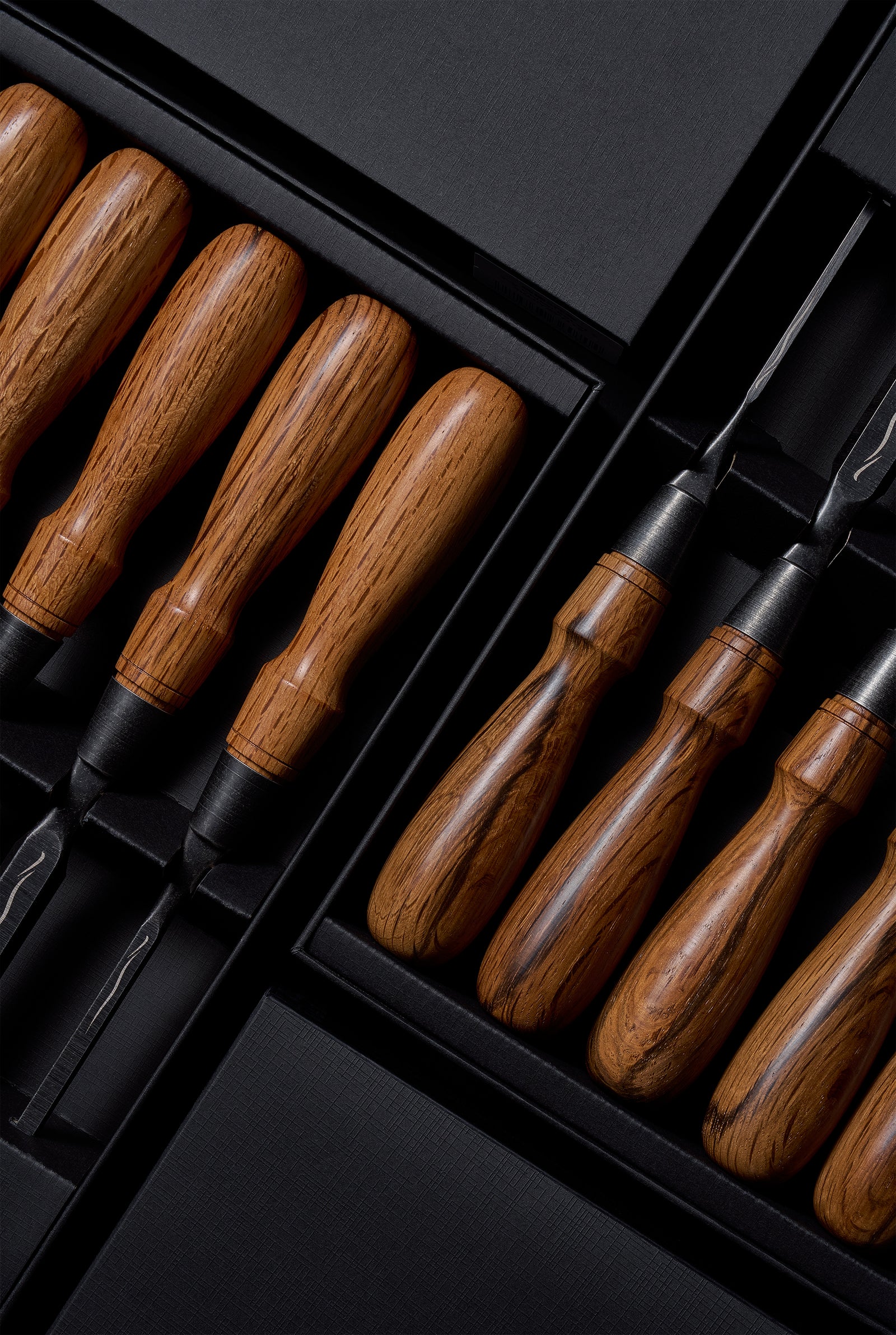
We use red ring-cup oak (红椆木) for chisel handles and for the bodies of our planes, always reclaimed old-growth stock. The color runs from pale to dark enough to pass for rosewood, with mineral streaks, ray fleck, and grain that shifts from one billet to the next. Two blanks off the same board can come out visibly different.
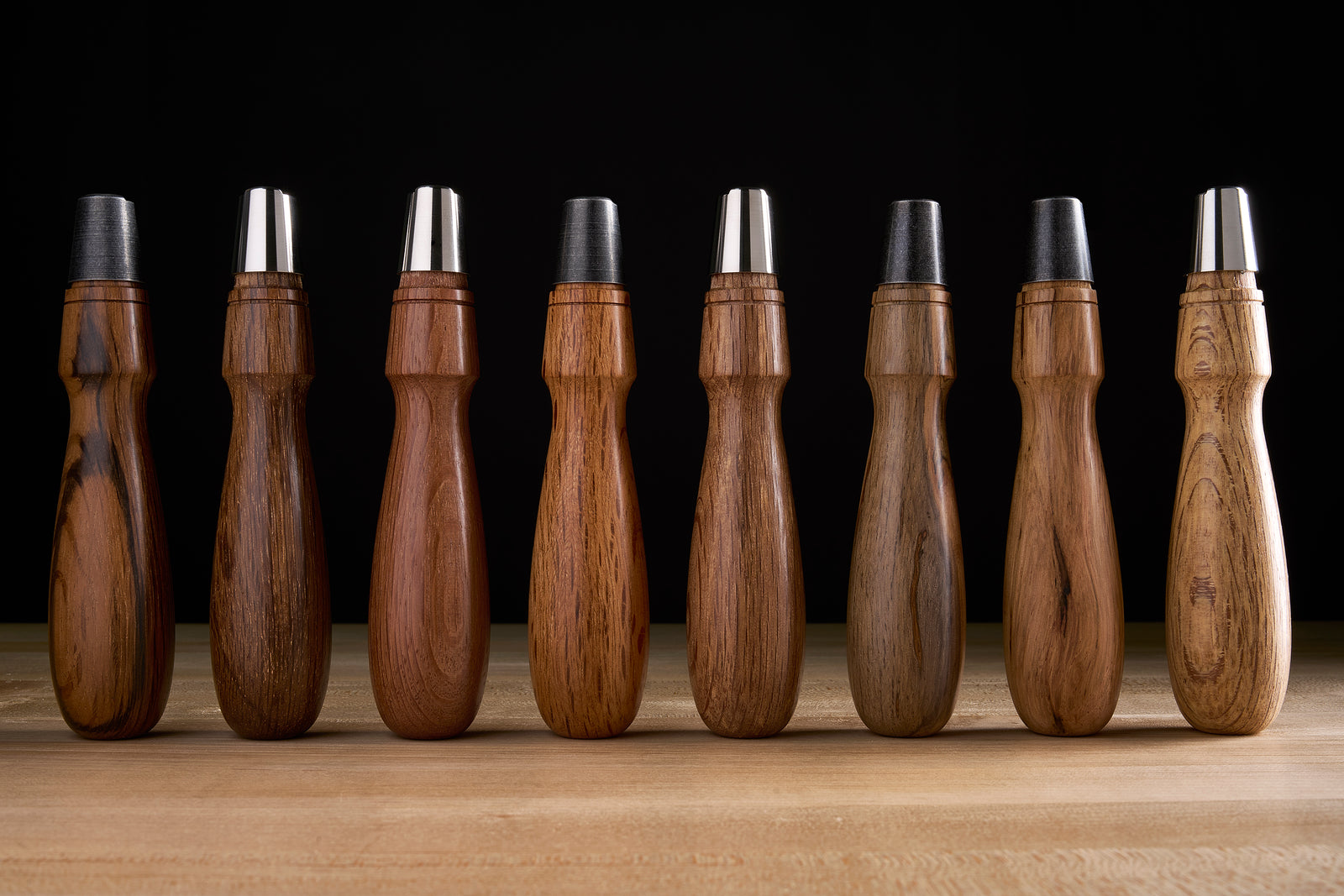
Botanically the wood is a ring-cupped evergreen oak, section Cyclobalanopsis (青冈类 in Chinese). It is a group, not a species: China alone has dozens, and reclaimed old-growth stock like ours is almost certainly a mix of several, hybrids among them. The closest single name is Quercus myrsinifolia, 小叶青冈, also sold as bamboo-leaf oak. The group is named for the cupule, the cap that holds the acorn: where the familiar deciduous oaks carry a cup of overlapping scales, these carry concentric rings, and that one character sets the whole lineage apart. The Flora of China keeps them in a genus of their own, Cyclobalanopsis; the consensus after Denk and colleagues' 2017 revision folds it back into Quercus. Either way it is an oak, but not the white or red oak the word usually brings to mind, which is deciduous and ring-porous, a separate lineage with different wood.

The name is not botanical, and even in Chinese it is usually written wrong. 椆 (chóu) is the timber character for these hard, dense evergreen oaks, a class that runs from the 青冈 ring-cup oaks to the 柯 (Lithocarpus). Our stock is the red kind, 红椆. It is usually written with one of two homophones instead, 红绸 (red silk) or 红稠 (red dense), neither of which is the timber character. Spelled any way, it names a grade, not a species: old stock whose heartwood has reddened with age, dense and tough enough to take a mallet. The people who cut it sort by density and toughness, not by species, so the name is already a kind of sorting, done before it reaches us.
Japan uses the same group of oaks. Their tool woods, the 樫 (kashi) oaks, are section Cyclobalanopsis too: 白樫 shirakashi is Q. myrsinifolia, one of the very species in our mix, and 赤樫 akagashi, sold in English as Japanese red oak, is a red-heartwood sibling, Q. acuta. Japanese plane dai and chisel handles are made from these same oaks, though much of what supplies them now is plantation-grown in Indonesia, lighter and less dense than old stock. The wood is shared across the two traditions. Japanese red oak names only one species of the group, so it is too narrow a name for our wood, which is a mix of the group.
The big old trees are mostly gone, and not for one reason. This oak has grown across much of China for a very long time, and the old-growth was drawn down slowly, over centuries of use. The last century took a harder cut, some of it, by the accounts we hear, milled and shipped to Japan. What is left reaches us as reclaimed stock. We do not use freshly cut wood: green, it checks and splits badly, and the red has not yet come in. So every piece we turn or plane is old, and no two trees, or two regions, grew quite the same wood.
China and Japan have long used it for handles and plane bodies because it is both hard and tough: it takes mallet blows without denting, and it does not split. Most woods manage one or the other, not both.
Because the wood varies this much, building a matched set is mostly sorting. We group handles close in color and grain, and that sorting is why a set costs us more than the same number of single chisels. Even sorted, no two are identical: the color is close, but the grain and mineral lines differ on every piece. Those differences are in the wood itself, not flaws in the work. Staining everything one dark brown would hide all of it, and any sign of what the wood is along with it. We would rather leave the mineral lines showing and do the sorting.
0 comments